 星海
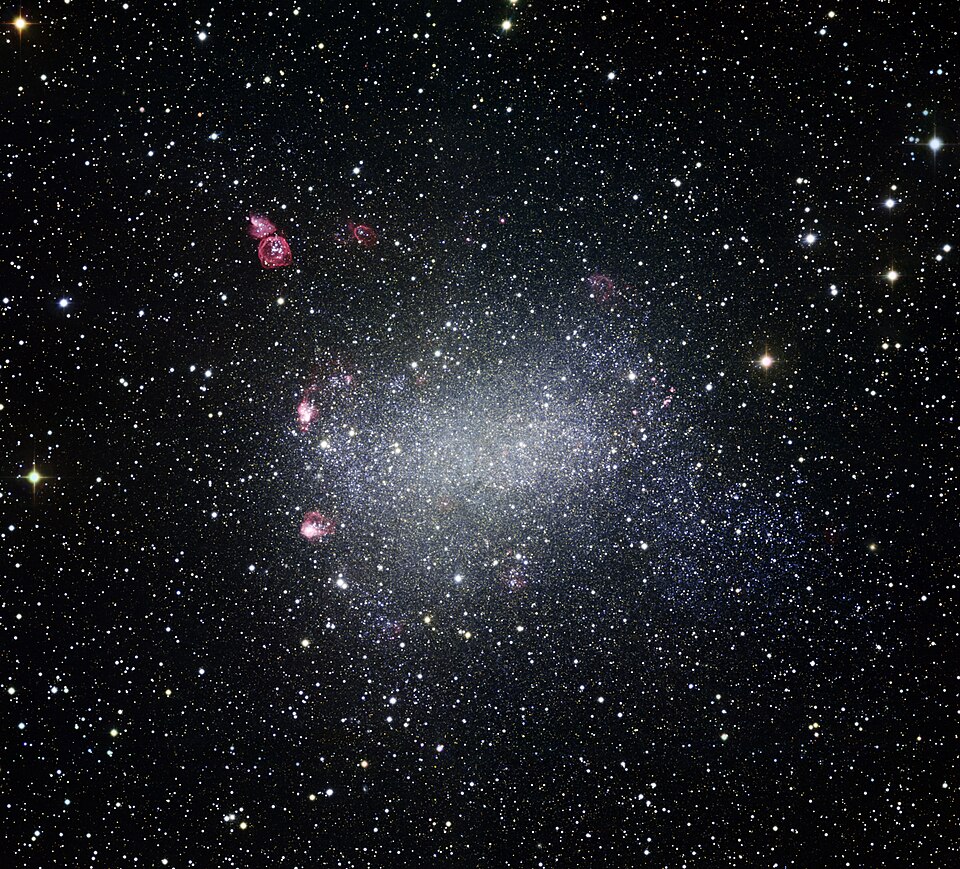
图:ESO,CC BY 4.0,维基共享资源
- 类型
- 星系
- 星座
- 人马座
- 视星等
- 10.05V
- B 星等
- 9.36
- 视大小
- 17.4′ × 16.8′
- 面亮度
- 24.25星等 / 平方角秒
- 哈勃分类
- IB
- 视向速度
- -57 km/s
- 红移
- -1.90×10⁻⁴
- 赤经(J2000)
- 19h 44m 57.7s
- 赤纬(J2000)
- −14° 48′ 12″
- 编号
- NGC 6822 · IC 4895
- 英文俗名
- Barnard's Galaxy
- 其他星表编号
- 2MASX J19445619-1447512 · C 057 · IRAS 19420-1450 · MCG -02-50-006 · PGC 063616
百科
巴纳德星系或称NGC 6822是一个位在人马座的有棒不规则星系,它距离地球160万光年,是本星系团的成员之一。
巴纳德星系在1881年由美籍天文学家爱德华·爱默生·巴纳德发现,并因此得名。
摘自中文维基百科「巴纳德星系」,按 CC BY-SA 4.0 使用。
英文维基百科
中文条目比较短,这里附上内容更多的英文维基百科条目原文(未翻译)。
NGC 6822 (also known as Barnard's Galaxy, IC 4895, or Caldwell 57) is a barred irregular galaxy approximately 1.6 million light-years away in the constellation Sagittarius. Part of the Local Group of galaxies, it was discovered by E. E. Barnard on 17 August 1884, with a six-inch refractor telescope. It is the closest non-satellite galaxy to the Milky Way, but lies just outside its virial radius. It is similar in structure and composition to the Small Magellanic Cloud. It is about 7,000 light-years in diameter.
Observational history
NGC 6822 was discovered by E. E. Barnard in 1884 using a six-inch refractor telescope.
Edwin Hubble, in the paper N.G.C. 6822, A Remote Stellar System, identified 15 variable stars (11 of which were Cepheids) of this galaxy. He also surveyed the galaxy's stars distribution down to magnitude 19.4. He provided spectral characteristics, luminosities and dimensions for the five brightest "diffuse nebulae" (giant H II regions) that included the Bubble Nebula and the Ring Nebula. He also computed the absolute magnitude of the entire galaxy.
Hubble's detection of eleven Cepheid variable stars was a milestone in astronomy. Utilizing the Cepheid Period-Luminosity relationship, Hubble determined a distance of 214 kiloparsecs or 698,000 light-years. This was the first system beyond the Magellanic Clouds to have its distance determined. (Hubble continued this process with the Andromeda Galaxy and the Triangulum Galaxy). This distance to the galaxy was way beyond Harlow Shapley's value of 300,000 light-years for the size of the universe. In the paper, Hubble concluded the "Great Debate" of 1920 between Heber Curtis and Shapley over the …
An analysis of Hubble's plates by Susan Kayser in 1966 remained the most complete study of this galaxy until 2002.
In 1977, Paul W. Hodge extended the list of known H II regions in Barnard to 16. Today, there are over 150 of these regions catalogued in Barnard's Galaxy.
Star formation
Observations of the galaxy show stars-forming in the dense cores of giant clouds of molecular hydrogen gas, cold enough to collapse under its own gravity. The distribution of hydrogen gas is disk-shaped, but mysteriously, it is angled at about 60° relative to the stellar distribution. Most of its stars formed within the last 3 to 5 billion years.
NGC 6822 has spent most of its life in relative isolation. However, it likely passed within the virial radius of the Milky Way some 3 to 4 billion years ago, which may be coincident with its increase in star formation.
以上取自英文维基百科「NGC 6822」(英文原文,未翻译),按 CC BY-SA 4.0 使用。
资料卡
- 类型
- 矮星系
- 距离
- 163 万光年
- 发现者
- 爱德华·爱默生·巴纳德
- 发现时间
- 1884 年 8 月 17 日
- 所属
- 本星系群、银河系
- 命名来源
- 爱德华·爱默生·巴纳德
数据来自 Wikidata(CC0),数值已换算成常用单位。
在星空中的位置
赤道坐标,上北下南、左东右西(跟从地面仰望一致)。在全天星图里打开 ›
同在人马座的深空天体
- 礁湖星云星云
- 三叶星云星云
- 欧米加星云星云
- M21 (疏散星团)疏散星团
- 梅西耶23疏散星团
- M70 / NGC 6681球状星团
- M28 (球状星团)球状星团
- M54 / NGC 6715球状星团
- M75 (球状星团)球状星团
- M22 (星团)球状星团
- M55 / NGC 6809球状星团
- 梅西耶69球状星团
- M18 (疏散星团)疏散星团
- 小人马座恒星云星协
- M25 (疏散星团)疏散星团