 星海
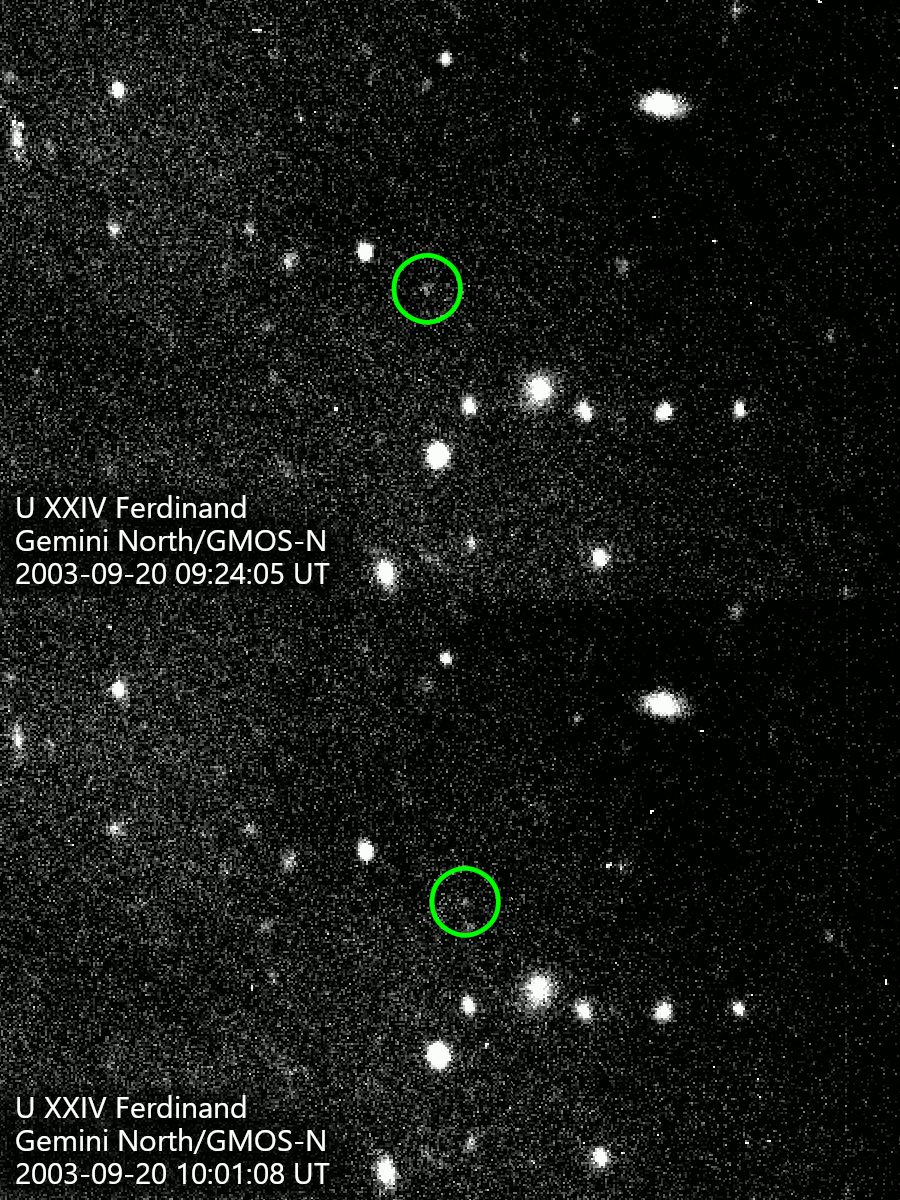
图:Images stacked & processed by Nrco0e. Original frames were taken by Scott S. Sheppard and stored in the public Gemini Ob,CC BY 4.0,维基共享资源
- 类型
- 卫星
- 绕着转
- 天王星
- 平均半径
- 10 千米
- 轨道半长轴
- 0.1397 天文单位
- 公转周期
- 7.905 年
- 轨道偏心率
- 0.3682
- 轨道倾角
- 170°
- 反照率
- 0.040
- 发现者
- 马修·霍尔曼、约翰·J·卡弗拉尔斯、Dan Milisavljevic
- 发现日期
- 2001 年 8 月 13 日
- 命名来源
- 费迪南(Ferdinand)
百科
天卫二十四(Ferdinand, S/2001 U 2)是环绕天王星运行的一颗卫星,于2001年8月13日由Matthew J. Holman、约翰·J·卡维拉尔斯、Dan Milisavljevic及布雷特·J·格拉德曼共同发现。其英文名以莎士比亚戏剧暴风雨中那不勒斯国王阿隆索之子腓迪南(Ferdinand)命名。
摘自中文维基百科「天卫二十四」,按 CC BY-SA 4.0 使用。
英文维基百科
中文条目比较短,这里附上内容更多的英文维基百科条目原文(未翻译)。
Ferdinand, also known as Uranus XXIV and previously as S/2001 U 2, is the outermost known moon of Uranus. It was discovered on 13 August 2001 by Dan Milisavljevic, Matthew J. Holman, JJ Kavelaars, and Tommy Grav at Cerro Tololo Inter-American Observatory in Chile. Named after a prince from William Shakespeare's play The Tempest, Ferdinand orbits Uranus at an average distance of 20.4 million km (12.7 million mi) and takes about 7.63 Earth years to complete one orbit. It follows a retrograde orbit, meaning it moves in the opposite direction to the planet's orbit around the Sun. Although Ferdinan…
Observational history
Discovery and loss
Ferdinand was discovered on 13 August 2001 by astronomers Dan Milisavljevic, Matthew J. Holman, JJ Kavelaars, and Tommy Grav, who at the time were searching for distant moons of Uranus. The discovery observations were made at Cerro Tololo Inter-American Observatory, Chile using the 4-meter Víctor M. Blanco Telescope equipped with a wide-field camera. The group identified Ferdinand and three other Uranian moons—Francisco, Trinculo, and Margaret—in the telescope images. The images were processed using the shift-and-add technique, which combines multiple exposures aligned to Uranus's motion.
To determine whether Ferdinand was orbiting Uranus, the group attempted to reobserve it with large optical telescopes, including the 5.1 m (200 in) Hale Telescope at Palomar Observatory. However, they were only able to detect Ferdinand on 21 September 2001; subsequent attempts were unsuccessful because the moon was too faint to detect reliably. With only two nights of observations, Ferdinand's orbit could not be determined and it became lost.
Recovery
Ferdinand was independently rediscovered by Scott S. Sheppard and David C. Jewitt on 29 August 2003, during their search for Uranian moons with the 8.3-meter (27 ft) Subaru Telescope at Mauna Kea Observatory. Unaware that Ferdinand had already been detected in 2001, Sheppard and Jewitt continued observing the apparently new moon on 20 September 2003, using the Gemini North telescope at Mauna Kea. On 24 September, Brian G. Marsden of the Minor Planet Center recognized that Sheppard and Jewitt had recovered Ferdinand. Holman confirmed Marsden's identification after observing Ferdinand from Las C…
For several years after its discovery, Ferdinand remained poorly observed and still had an uncertain orbit, which put it at risk of being lost again. To improve the understanding of its orbit, a team led by Robert A. Jacobson and Marina Brozović conducted a campaign to reobserve Ferdinand and several other poorly observed moons from 2009 to 2011. Although Ferdinand's orbital uncertainty persisted after these observations, its slow orbit around Uranus ensured that it would not be lost again by the next century. Ferdinand remained unobserved until 8 September 2021, when Sheppard began another se…
Name
When the discovery of Ferdinand was announced, it was given the temporary provisional designation "S/2001 U 2" by the Minor Planet Center. It was later named and given the Roman numeral designation Uranus XXIV by the International Astronomical Union's Working Group for Planetary System Nomenclature on 29 December 2005. The moon was named after Ferdinand, the son of the King of Naples in William Shakespeare's play The Tempest.
Orbit
Ferdinand is one of Uranus's irregular moons, which follow wide, eccentric, and inclined orbits in contrast to the regular moons of Uranus. Irregular moons like Ferdinand are thought to have been captured by their planet during the Solar System's formation. The Uranian irregular moons are loosely bound by Uranus's gravity due to their great distance from the planet, which makes their orbits susceptible to gravitational perturbations by the Sun and other planets. This results in significant changes to their orbits over short periods of time, so a simple Keplerian elliptical orbit cannot accurat…
Ferdinand is the outermost known moon of Uranus, having an average semi-major axis of 20.4 million km (12.7 million mi; 0.136 AU) and an average orbital period of 7.63 years (2,788 days). Its orbit occupies 29% of Uranus's Hill radius—a relatively small fraction of the planet's gravitational extent compared to the outermost moons of other giant planets, which orbit near 50% of their planet's Hill radius. With an average orbital eccentricity of 0.4 and an average inclination of 169° with respect to the ecliptic, Ferdinand follows a retrograde orbit, meaning it moves in the opposite direction to…
Over a 10,000-year time span, Ferdinand's semi-major axis varies from 20.1 to 20.9 million km (12.5 to 13.0 million mi; 0.134 to 0.140 AU) while its orbital period varies from 7.44 to 7.89 years (2,719 to 2,882 days). Ferdinand's eccentricity also varies from 0.31 to 0.49, while its inclination with respect to the ecliptic varies from 167° to 172°. Its orbit exhibits both apsidal and nodal precession with periods of 747 and 1,001 years, respectively. Ferdinand's orbit allows occasional close approaches to Uranus's largest irregular moon, Sycorax, which may gravitationally perturb its orbit.
It is unclear whether Ferdinand belongs to a collisional family of Uranian irregular moons. If Ferdinand were the largest surviving member of such a family, most fragments produced by the original collision would likely have escaped Uranus's gravitational influence due to the moon's great distance from the planet. Studies in the 2000s tentatively grouped Ferdinand with Sycorax, Setebos, and Prospero, as all four moons occupy distant, highly eccentric orbits with semi-major axes exceeding 16 million km (9.9 million mi; 0.11 AU) and eccentricities greater than 0.5. A 2005 study led by Sheppard a…
Physical characteristics
In red light (R band), Ferdinand appears very faint with an apparent magnitude of 25.1. For this reason, it can only be observed through long-exposure imaging with large-aperture telescopes. Like other Uranian irregular moons, Ferdinand is expected to have a dark surface composed of water ice, hydrated silicates, and organic compounds. Infrared observations by the Herschel Space Observatory detected no significant thermal emission from Ferdinand, indicating it must have a geometric albedo higher than 0.03 and a diameter smaller than 50 km (31 mi). Assuming Ferdinand has a low albedo of 0.04 li…
Ferdinand's brightness varies periodically as it rotates, which indicates it has an elongated shape. Kepler observations in 2017 measured a brightness variation of 0.54±0.09 magnitudes, implying an equatorial semi-axis ratio (a/b) greater than 1.6. The rotation period of Ferdinand is ambiguous, as it depends on whether its light curve is single-peaked or double-peaked. If Ferdinand's light curve is single-peaked, its rotation period would be 11.84±0.22 hours. If its light curve is double-peaked, then its rotation period would be 23.68±0.50 hours, twice the single-peak period. In either case, F…
以上取自英文维基百科「Ferdinand (moon)」(英文原文,未翻译),按 CC BY-SA 4.0 使用。原文约 7,340 字符,这里节选前 6,875 字符,全文请看原条目。