星海
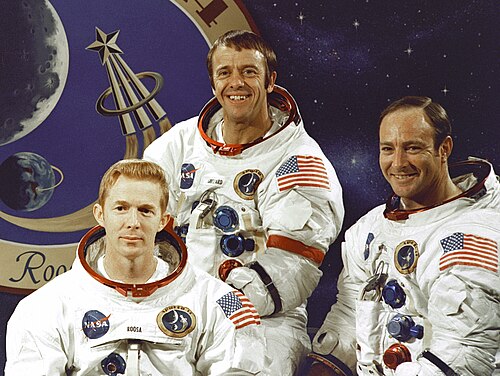
图:NASA/Alan Shepard,Public domain,维基共享资源
- 出生
- 1930 年 9 月 17 日
- 去世
- 2016 年 2 月 4 日
- 国籍
- 美国
- 性别
- 男
- 在太空的时间
- 9.001 天
- 执行过的任务
- 阿波罗14号
百科
艾德加·迪恩·米切尔(英语:Edgar Dean Mitchell,1930年9月17日—2016年2月4日)曾是一位美国国家航空航天局的宇航员,执行过阿波罗14号任务。执行阿波罗14号任务时,米切尔成为了第六个踏上月球的人。
摘自中文维基百科「艾德加·米切尔」,按 CC BY-SA 4.0 使用。
英文维基百科
中文条目比较短,这里附上内容更多的英文维基百科条目原文(未翻译)。
Edgar Dean Mitchell (September 17, 1930 – February 4, 2016) was a United States Navy officer and aviator, test pilot, aeronautical engineer, ufologist, and NASA astronaut. As the Lunar Module Pilot of Apollo 14 in 1971 he spent nine hours working on the lunar surface in the Fra Mauro Highlands region, and was the sixth person to walk on the Moon.
Before becoming an astronaut, Mitchell earned his Bachelor of Science degree in Industrial Management from Carnegie Institute of Technology and entered the United States Navy in 1952. After being commissioned through the Officer Candidate School at Newport, Rhode Island, he served as a Naval Aviator. In 1961, he received his second bachelor's degree, in aeronautical engineering, from the U.S. Naval Postgraduate School and three years later earned his doctorate in Aeronautics and Astronautics from the Massachusetts Institute of Technology (MIT). From 1965 to 1966, he attended the U.S. Air Force…
The legacy of his post-NASA scientific and parapsychology work is carried on through the Institute of Noetic Sciences.
Early life and education
Mitchell was born on September 17, 1930, in Hereford, Texas, to Joseph Thomas Mitchell and Ollidean Margaret Mitchell (née Arnold). He had three siblings: Joyce Alyene, who died in her infancy in 1933, Sandra Jo, and Jay Neely "Coach", who was a member of the inaugural graduating class of the United States Air Force Academy in 1959, and a pilot with the United States Air Force (USAF), achieving the rank of colonel. He came from a ranching family that moved to New Mexico during the Depression and considered Artesia, New Mexico (near Roswell) as his hometown. He first learned to fly at 13, recei…
He graduated from Artesia High School in 1948. Mitchell received a Bachelor of Science degree in industrial management from the Carnegie Institute of Technology (now Carnegie Mellon University) in 1952, where he was a member of Kappa Sigma fraternity. That same year, he entered the United States Navy and completed basic training at San Diego Recruit Depot. While on active duty in the Navy, he earned a second bachelor's degree, in aeronautical engineering, from the U.S. Naval Postgraduate School in 1961 and a Doctor of Science degree in aeronautics and astronautics from the Massachusetts Instit…
Flight experience
In May 1953, after completing instruction at the Officer Candidate School at Newport, Rhode Island, Mitchell was commissioned an ensign. He completed flight training in July 1954 at Hutchinson, Kansas, was designated as a Naval Aviator and received the Daughters of the American Revolution Award for achieving the highest overall marks during flight training. After period of instruction from July to September 1954 at the Fleet Airborne Electronics Training Unit, U.S. Pacific Fleet, Mitchell was subsequently assigned to Patrol Squadron 29 (VP-29), flying land-based patrol planes, deployed to Okin…
From 1957 to 1958, Mitchell transitioned to carrier-based jet aircraft and flew the A3D Skywarrior while assigned to Heavy Attack Squadron Two (VAH-2) deployed aboard the aircraft carriers USS Bon Homme Richard and USS Ticonderoga. He qualified as a research pilot and flew with Air Development Squadron Five until 1959. Following the completion of his graduate studies, Mitchell served as Chief, Project Management Division of the Navy Field Office for the Manned Orbiting Laboratory from 1964 to 1965. From 1965 to 1966, he attended the U.S. Air Force Aerospace Research Pilot School (Class 65B) fo…
Mitchell accumulated 5,000 hours flight time, including 2,000 hours in jet aircraft.
NASA career
Mitchell was selected in 1966 as part of NASA's fifth astronaut group. He was assigned to the support crew for Apollo 9, then was designated as backup Lunar Module Pilot for Apollo 10. This placed him in rotation for Apollo 13, but his crew was switched to Apollo 14 so that Commander Alan Shepard, who had been grounded by a medical problem since the Gemini program, could train longer.
During the Apollo 13 crisis, Mitchell was a part of the Apollo 13 Mission Operations Team and as such was awarded the Presidential Medal of Freedom by President Richard M. Nixon in 1970. He worked in an Apollo simulator to help bring the crew back. One issue he worked on was how to "fly" (meaning control the attitude of) the Lunar Module with an inert Apollo Command/Service Module attached to it. (Usually, it was the other way around, but the Service Module was damaged during that mission.)
He then went to serve as Lunar Module Pilot on Apollo 14, landing with Shepard aboard the Lunar Module Antares on February 5, 1971, in the hilly upland Fra Mauro Highlands region of the Moon. They stayed on the Moon for 33 hours, deployed and activated lunar surface scientific equipment and experiments, and collected almost 100 pounds of lunar samples for return to Earth. Other Apollo 14 achievements include: only use of the Mobile Equipment Transporter (MET); first successful use of color television with a new Vidicon tube; longest distance traversed on foot on the lunar surface; largest payl…
In completing his first space flight, Mitchell logged a total of 216 hours and 42 minutes in space. He was subsequently designated to serve as backup Lunar Module Pilot for Apollo 16.
During the mission, he took photos, including the one with Shepard raising the American flag. In the photo, Mitchell's shadow is cast over the lunar surface near the flag. That photo was listed on Popular Science's photo gallery of the best astronaut selfies.
You develop an instant global consciousness, a people orientation, an intense dissatisfaction with the state of the world, and a compulsion to do something about it. From out there on the moon, international politics look so petty. You want to grab a politician by the scruff of the neck and drag him a quarter of a million miles out and say, "Look at that, you son of a bitch."
Post-NASA career
Mitchell's interests included consciousness and paranormal phenomena. On his way back to Earth during the Apollo 14 flight he had a powerful savikalpa samādhi experience, and he claimed to have conducted private ESP experiments with his friends on Earth. The results of these experiments were published in the Journal of Parapsychology in 1971.
He retired from NASA and the U.S. Navy with the rank of captain in October 1972. Immediately thereafter, he founded Edgar D. Mitchell & Associates of Monterey, California, a "commercial organization promoting ecologically-pure products and services designed to alleviate planetary problems."
以上取自英文维基百科「Edgar Mitchell」(英文原文,未翻译),按 CC BY-SA 4.0 使用。原文约 16,041 字符,这里节选前 6,493 字符,全文请看原条目。
资料卡
- 出生地
- 希尔福德
- 去世地
- 西棕榈滩
- 职业
- 军官、航天员、飞行员、航空工程师、商人、编剧
- 毕业 / 就读
- 麻省理工学院、美国空军试飞员学校、卡内基梅隆大学、美国海军研究生院
- 工作单位
- 美国国家航空航天局
- 军种
- 美国海军
- 军衔
- 海军上校
- 荣誉
- 总统自由勋章、海军杰出服役勋章、美国宇航局杰出服务奖章、美国宇航员名人堂、International Space Hall of Fame
数据来自 Wikidata(CC0),数值已换算成常用单位。