 星海
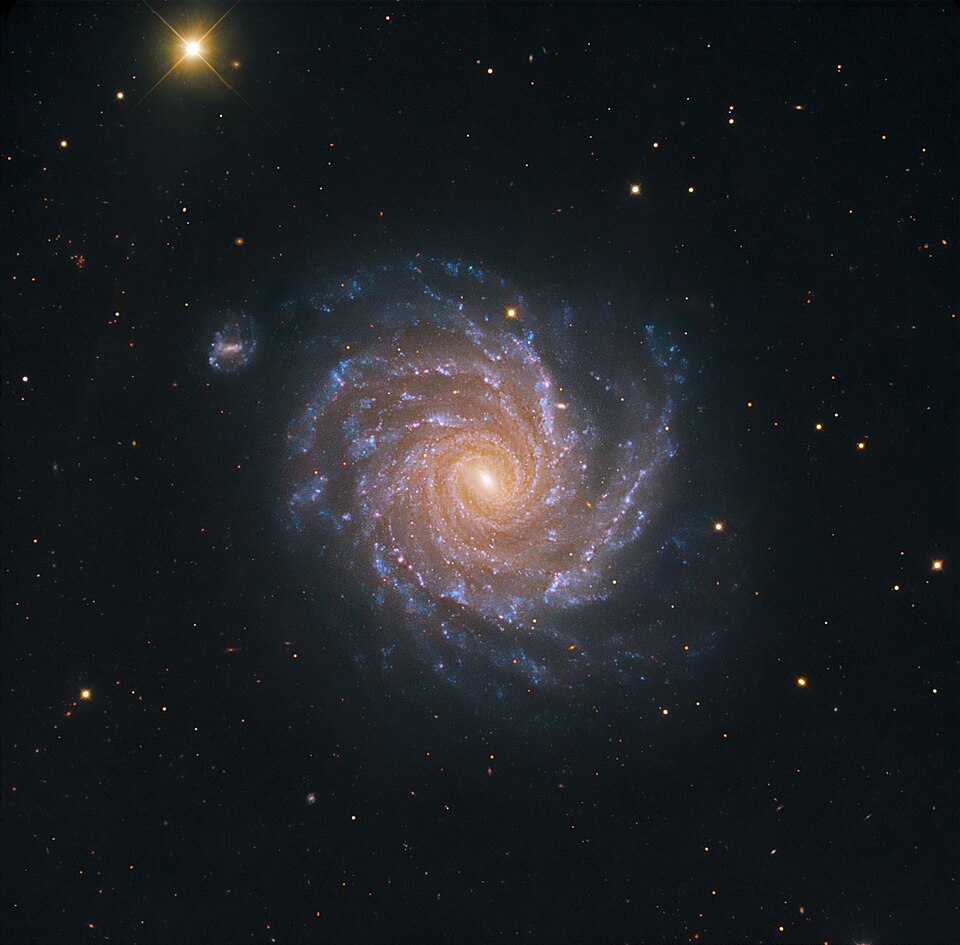
图:ESO/IDA/Danish 1.5 m/R.Gendler and A. Hornstrup.,CC BY 4.0,维基共享资源
- 类型
- 星系
- 星座
- 波江座
- 视星等
- 10.11V
- B 星等
- 10.56
- 视大小
- 6.79′ × 5.77′
- 面亮度
- 23.33星等 / 平方角秒
- 哈勃分类
- SABc
- 视向速度
- 1,677 km/s
- 红移
- 0.00561
- 赤经(J2000)
- 3h 09m 45.5s
- 赤纬(J2000)
- −20° 34′ 46″
- 编号
- NGC 1232
- 其他星表编号
- 2MASX J03094551-2034454 · ESO 547-014 · ESO-LV 547-0140 · IRAS 03074-2045 · MCG -04-08-032 · PGC 011819
百科
NGC 1232 是波江座的一个中间螺旋星系,距离地球约6000万光年。由弗里德里希·威廉·赫歇尔发现于1784年10月20日。
概要
NGC 1232环绕中心的螺旋臂内有大量明亮恒星与暗灰尘。螺旋臂内的疏散星团内有大量蓝色恒星沿着螺旋臂分布,其间有大量的星际尘埃暗区。较暗的恒星和星际气体占了星系质量大部分,并且主导了星系内侧动力状态。而星系外侧可见物体的动力模式则必须以目前无法被直接观察的暗物质的存在解释。
NGC 1232和它的卫星星系,以及另一个大星系NGC 1300是波江座星系团的成员星系。
ESO 547-16
ESO 547-16,即NGC 1232A是NGC 1232的卫星星系。一般认为它的形成是因为螺旋臂内异常扭曲造成。1988年的观测结果,NGC 1232A距离地球约6800万光年,而NGC 1232距离地球约6000万光年。
摘自中文维基百科「NGC 1232」,按 CC BY-SA 4.0 使用。
英文维基百科
中文条目比较短,这里附上内容更多的英文维基百科条目原文(未翻译)。
NGC 1232, also known as the Eye of God Galaxy is an intermediate spiral galaxy about 50 million light-years away in the constellation Eridanus. It was discovered by German-British astronomer William Herschel on 20 October 1784.
It is dominated by millions of bright stars and dark dust, in spiral arms rotating about the center. Open clusters containing bright blue stars are sprinkled along these spiral arms, with dark lanes of dense interstellar dust between. Less visible are dimmer stars and interstellar gas, comprising such a high mass that they dominate the dynamics of the inner galaxy. Not visible is matter of unknown form called dark matter, needed to explain the motions of the visible material in the outer galaxy. The galaxy is approximately 150,000 light-years across. The galaxy's spiral arms are not smooth and…
NGC 1232 and its apparent companions are possibly part of the Eridanus Cluster of galaxies, along with NGC 1300.
Description and structure
NGC 1232 is a face-on spiral galaxy. It can be technically considered a grand-design galaxy and is considered a prototype for multi-arm spiral galaxies. Its galactic bulge is small. While NGC 1232 is classified as an intermediate spiral galaxy, the bulge shows hints of a galactic bar.
Spiral arms
NGC 1232's spiral arms are bright and flocculent, winding counterclockwise from the galactic center. They contain numerous HII regions. At large distances from the galaxy's center, the spiral arms either branch out and disperse, producing long spiral arms, or connect with arm segments. However, they are not smooth as expected for a spiral galaxy. Instead, they bend abruptly and show significant deviations from a constant pitch. In fact, the same pitch angle cannot be applied to one arm due to the arms deviating. Astronomer Halton Arp suggested that this is the result of a galaxy interaction. T…
Most of NGC 1232's arms and arm segments widen as they get farther and farther away from the galaxy's center with only one arm or arm segment, designated as arm segment "E", narrowing as it gets further from the center. This is likely due to less and less star formation occurring at farther distances from the galaxy's center, or it may be because the spiral arm reaches a point where the spiral pattern starts to co-rotate orbiting material.
Association with the Eridanus cluster
NGC 1232 and NGC 1232 A may both be associated with the Eridanus cluster of galaxies, but with a distance of around 2.2 million parsecs from the cluster's center, they may not be bound to the cluster.
Debated collision with another dwarf galaxy and association with NGC 1232A
It was originally thought that one of NGC 1232's companions, NGC 1232A, was interacting with NGC 1232 and causing perturbations within its disk, as NGC 1232A seems to be a satellite galaxy of NGC 1232 at first sight, but this is likely not the case. In 1988, NGC 1232A was estimated to be 68 million light-years away while NGC 1232 was estimated to be 65 million light-years away. The redshifts of the two galaxies do not match, which suggest that they likely never interacted before and are not currently interacting. The discrepant redshifts for the two galaxies is one of the reasons why the pair …
X-Ray observations over a three-year period made by the Chandra X-ray observatory also suggest that there was an interaction between NGC 1232 and another dwarf galaxy, commenting on a massive cloud of gas only visible in the X-ray superimposed on NGC 1232's images. The paper concludes that this may be the first case of the dwarf galaxy-large galaxy collision whose evidence is only visible in the X-Ray. However, it is noted that this may be due to other causes, such as numerous supernovae, but the study also suggests that there is no other evidence for this. As a result, an interaction with ano…
In contrast with previous studies, a recent X-Ray study remarks that the hot gas luminosity in NGC 1232 is not very high. According to the study, the cloud claimed to be superimposed on NGC 1232 does not exist, and that peculiarities in NGC 1232's HII regions are just coincidental. The study notes that NGC 1232's disk is not very warped. Thus, the study concludes that there was no interaction between either NGC 1232A or another dwarf galaxy and NGC 1232 at all.
以上取自英文维基百科「NGC 1232」(英文原文,未翻译),按 CC BY-SA 4.0 使用。
资料卡
- 类型
- emission-line galaxy、螺旋星系
- 距离
- 4,566 万光年
- 发现者
- 威廉·赫歇尔
- 发现时间
- 1784 年 10 月 20 日
- 所属
- 波江座星系团
数据来自 Wikidata(CC0),数值已换算成常用单位。
在星空中的位置
赤道坐标,上北下南、左东右西(跟从地面仰望一致)。在全天星图里打开 ›