 星海
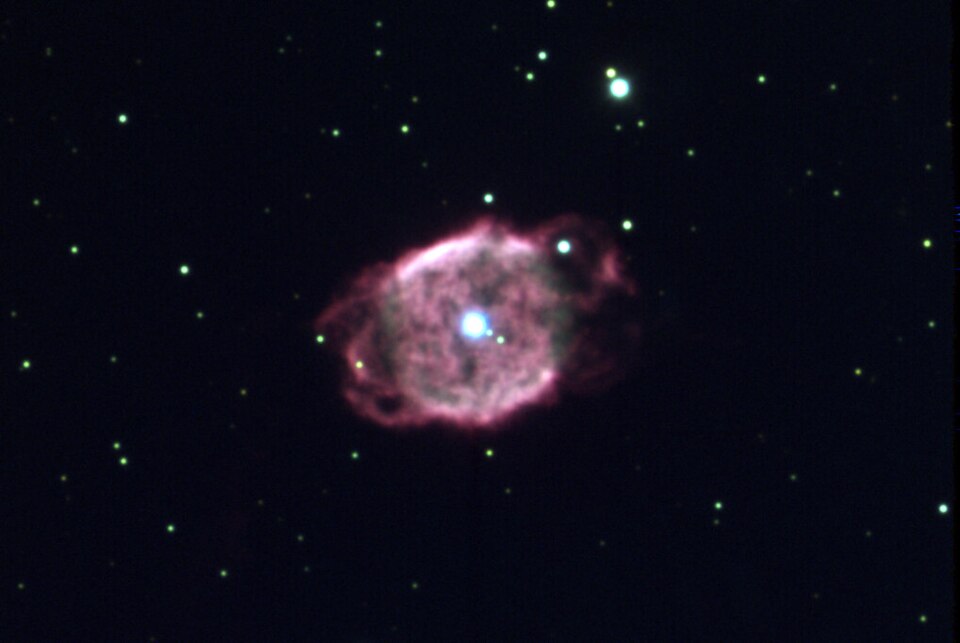
图:Credit: WIYN/NOIRLab/NSF,CC BY 4.0,维基共享资源
- 类型
- 行星状星云
- 星座
- 仙王座
- 视星等
- 11.89V
- B 星等
- 11.27
- 视大小
- 0.8′
- 视向速度
- -20 km/s
- 红移
- -6.80×10⁻⁵
- 赤经(J2000)
- 0h 13m 01.0s
- 赤纬(J2000)
- +72° 31′ 19″
- 编号
- NGC 40
- 英文俗名
- Bow-Tie nebula
- 中心星
- HD 000826,HIP 001041,TYC 4302-01297-1
- 其他星表编号
- C 002 · IRAS 00102+7214 · PN G120.0+09.8
百科
NGC 40,也称为蝴蝶结星云和科德韦尔2,是威廉·赫歇尔在1788年11月25日发现的一个行星状星云。这颗垂死的恒星已经抛出了它的外壳,并且留下较小、且有炙热气体围绕着的,表面温度高达50,000K;来自恒星的辐射导致外层倍加热至10,000K,并且膨胀至约1光年的直径。 科学家估计,在30,000年后,NGC 40将逐渐暗淡,而只留下一颗如同地球大小的白矮星。
摘自中文维基百科「NGC 40」,按 CC BY-SA 4.0 使用。
英文维基百科
中文条目比较短,这里附上内容更多的英文维基百科条目原文(未翻译)。
NGC 40, also known as the Bow-Tie Nebula or Caldwell 2, is a planetary nebula located around 5280 light years (1619 parsecs) from Earth in the Constellation of Cepheus. The nebula is about one light-year across. It was discovered by William Herschel on November 25, 1788.
The nebula formed due to a dying star ejecting its outer layers of gas leaving behind a small, hot stellar remnant known as a white dwarf. Radiation from the star causes the shed outer layer to heat to about 10,000 degrees Celsius and become visible as a planetary nebula. About 30,000 years from now, scientists theorize that NGC 40 will fade away, leaving only a white dwarf star approximately the size of Earth.
Structure
The main structure of NGC 40 has a barrel-like shape with two moves expanding towards the northern and southern directions. The long axis pointing towards the north-northeast. There are two additional pairs of lobes around the poles, which correspond to additional ejections from the star. There is a cavity located in NGC 40 that is around 6500 years old. The northern and southern lobes were ejected around 4200 years ago.
Central star
The central star of NGC 40 has a Henry Draper Catalogue designation of HD 826. It has a spectral type of [WC8], indicating a spectrum similar to that of a carbon-rich Wolf–Rayet star. The central star has a bolometric luminosity of about 7,000 L☉ and radius of 0.56 R☉.
The star appears to have an effective temperature of about 71,000 K, but the temperature of the source ionizing the nebula is only about 45,000 K. One proposed explanation to this contradiction is that the star was previously cooler, but has experienced a late thermal pulse which re-ignited fusion and caused its temperature to increase.
以上取自英文维基百科「NGC 40」(英文原文,未翻译),按 CC BY-SA 4.0 使用。
资料卡
- 类型
- 行星状星云、near-infrared source
- 距离
- 6,470 光年
- 发现者
- 威廉·赫歇尔
- 发现时间
- 1788 年 11 月 25 日
数据来自 Wikidata(CC0),数值已换算成常用单位。
在星空中的位置
赤道坐标,上北下南、左东右西(跟从地面仰望一致)。在全天星图里打开 ›
同在仙王座的深空天体
其他行星状星云
- 猫眼星云天龙座
- 环状星云天琴座
- Owl Nebula大熊座
- 螺旋星云宝瓶座
- 哑铃星云狐狸座
- 小哑铃星云英仙座
- Saturn Nebula宝瓶座
- Eight-Burst Nebula船帆座
- 爱斯基摩星云双子座
- Bug Nebula天蝎座
- 木星状星云长蛇座
- 红蜘蛛星云人马座