 星海
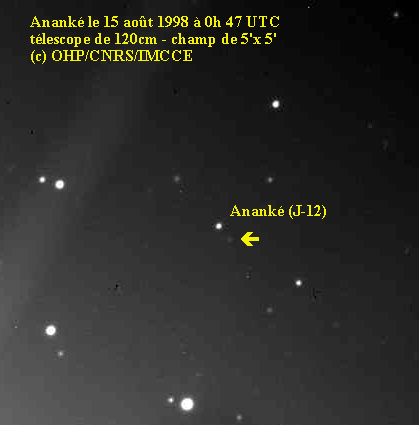
图:OHP (Observatoire de Haute-Provence) / CNRS (Centre national de la recherche scientifique) / IMCCE (Institut de mécaniqu,CC BY-SA 2.0 fr,维基共享资源
- 类型
- 卫星
- 绕着转
- 木星
- 平均半径
- 15 千米
- 质量
- 3.000×10¹⁹ 千克地球的 5.02×10⁻⁶ 倍
- 平均密度
- 2,325 克 / 立方厘米
- 轨道半长轴
- 0.1366 天文单位
- 公转周期
- -14,966 小时
- 轨道偏心率
- 0.2400
- 轨道倾角
- 148.7°
- 自转周期
- 8.31 小时
- 反照率
- 0.038
- 发现者
- 赛斯·尼克尔森
- 发现日期
- 1951 年 9 月 28 日
- 命名来源
- 阿南刻
百科
木卫十二又称为“阿南刻”(Ananke),是木星的其中一颗卫星,它是一颗逆行的不规则卫星,在1951年被赛斯·尼克尔森于威尔逊山天文台发现,并命运女神阿南刻命名。
直到1975年前,木卫十二也没有一个正式的名称,它一直只有一个简单的编号——“木星XII”。在1955年至1975年之间,人们叫它做阿德剌斯忒亚,而阿德剌斯忒亚现在是木星另一颗卫星木卫十五的名字。
轨道
木卫十二的轨道非常奇特,不但离心率非常的高,而且轨道也非常倾斜(高达150°)因此它被归为不规则卫星。
摘自中文维基百科「木卫十二」,按 CC BY-SA 4.0 使用。
英文维基百科
中文条目比较短,这里附上内容更多的英文维基百科条目原文(未翻译)。
Ananke , also known as Jupiter XII, is a natural satellite or moon of Jupiter. It is one of Jupiter's irregular moons, which orbit far from the planet on highly inclined and eccentric orbits. Ananke was discovered by Seth Barnes Nicholson at Mount Wilson Observatory in 1951.
It orbits Jupiter in the retrograde direction—opposite to the direction of the planet's rotation—at an average distance of 21.0 million km (13.0 million mi). It is the largest member of the Ananke group, a group moons are believed to be fragments of an asteroid or trans-Neptunian object that was gravitationally captured by Jupiter and destroyed by a collision several billion years ago. Most of Ananke 's physical properties are unknown, it to be about 29 km in diameter and its surface is be dark and boundary between grey and light red.
Discovery and naming
It was discovered by Seth Barnes Nicholson at Mount Wilson Observatory in 1951.
It is named after the Greek mythological Ananke, the personification of necessity, and the mother of the Moirai (Fates) by Zeus. Ananke did not receive its present name until 1975; before then, it was simply known as Jupiter XII. It was sometimes called "Adrastea" between 1955 and 1975 (Adrastea is now the name of another satellite of Jupiter).
Orbit
The satellite orbits Jupiter at a mean distance of 21,042,470 km and completes one orbit in 623,59 days. Its orbit has an inclination of 149° relative to the ecliptic and an eccentricity of 0.174. The orbit is subject to continuous changes due to gravitational perturbation from the Sun and the other planets.
Group membership and origin
Ananke gives its name to the Ananke group, a group of irregular retrograde Jovian moons. Members of this group orbit Jupiter at distances of approximately 19 to 22 million km, with orbital inclinations ranging from 144° to 156° and eccentricities between 0.10 and 0.30. The moons of the Ananke group are believed to be fragments of an asteroid or trans-Neptunian object that was gravitationally captured by Jupiter and destroyed by a collision several billion years ago.
Physical characteristics
According to thermal infrared measurements by the WISE space telescope, Ananke has an albedo of approximately 3.8%. Based on this value, the moon is estimated to have a diameter of approximately 29.1 km. The shape of the moon is currently unknown. However, given its small size, Ananke is likely to have an irregular shape, similar to other irregular moons.
The mass from Ananke (1.68×10¹⁶ kg) was calculated using a density value of 1,30 typical of P-type asteroid.
In the visible spectrum, Ananke appears neutral to light-red (colour indices B-V=0.90 V-R=0.38). The infrared spectrum is similar to P-type asteroid s but with a possible indication of water.
The rotation period was determined to be approximately 8 hours and 18.6 minutes with a peak amplitude of about ~0.4 magnitudes. This was regarded by a later paper as uncertain due to the short observation periods.
Exploration
Ananke has not been imaged up close by a space probe. All Jupiter irregular moons including Ananke are planned to be distant observation targets for the European Space Agency's Jupiter Icy Moons Explorer (Juice) mission, which will measure the Jupiter irregular moons' rotation periods and shapes by watching their brightness change over time.
以上取自英文维基百科「Ananke (moon)」(英文原文,未翻译),按 CC BY-SA 4.0 使用。